Why Tankless Heaters Take the Hit Faster Than Tank Heaters
A traditional tank water heater builds up scale slowly and keeps working for years past the point where it is efficient. The tank absorbs a lot of that punishment before anything visibly breaks. A tankless unit works differently. Every gallon of water passes continuously through a compact heat exchanger, usually a coiled set of copper or stainless fins, and is heated on demand with no buffer in between. At 12 GPG untreated, calcium deposits directly onto those fins with every gallon that moves through. There is nowhere for the scale to go except exactly where it will do the most damage.
What that looks like in practice is a gradual pressure drop and efficiency loss that the homeowner usually does not notice until the unit starts throwing flow error codes. From what I have seen on installs, a tankless heater running on untreated hard water at 12 GPG or above typically starts showing visible heat exchanger restriction within 3 to 5 years. By year 7, many of those units need replacement. The same model installed with a softener upstream can often run 15 years or more with far fewer heat exchanger issues. In many installs, that difference comes down largely to water quality.
Field Note: I have pulled apart heat exchangers on units that were 4 to 5 years old and looked like the inside of a kettle left on hard water for a decade. The fins were almost completely bridged with calcium. The homeowner had no idea anything was wrong until the error codes started. Water tested at 16 GPG. No softener had ever been installed. That heater was not repairable, and it was well within the age where it should have been running without problems.
The continuous-flow design is what makes the difference. Scale has no buffer to hide in. It accumulates on the exact surfaces responsible for heat transfer, and the restriction compounds with every hot-water draw because no softener is removing hardness before the water reaches the heat exchanger.
What Your Warranty Actually Says About Water Hardness
Most tankless water heater manufacturers specify a maximum water hardness level in their installation documentation. The threshold varies by brand, but the range I see most consistently in the field is 7 to 11 GPG. Below that number, the manufacturer considers the heater operating within acceptable water quality. Above it, they expect water treatment to be installed. When scale damage occurs in a unit running above the stated hardness limit with no treatment upstream, it is classified as an improper installation condition, not a product defect. The warranty does not apply.
This is worth reading directly in your specific model’s documentation before you plan the installation. The hardness limit is almost always buried in the installation manual under water quality requirements, not in the general warranty terms that come in the box. One contractor familiar with warranty claims on these units put it plainly: the manufacturer will void the warranty if the stated hardness limit is exceeded without a softener or approved treatment in place. The manual is what matters, not what the sales rep said at the showroom.
| Water Hardness | Risk to Tankless Heater | Common Risk Pattern Without Treatment | Treatment Required |
|---|---|---|---|
| Under 7 GPG | Low | 10 or more years before scale issues | Usually none by warranty terms |
| 7 to 11 GPG | Moderate | 5 to 8 years without treatment | Softener or conditioner, check exact warranty language |
| 12 to 20 GPG | High | 3 to 5 years without treatment | Ion exchange softener |
| Above 20 GPG | Severe | 1 to 3 years without treatment | Ion exchange softener, sediment pre-filter recommended |
The timelines above come from patterns across real installations and community reports, not manufacturer marketing materials. Your specific situation depends on usage volume, flow rate, and whether you do any periodic descaling maintenance. But the direction is consistent across every source I have come across, and most residential water in the US falls somewhere in the 7 to 25 GPG range. If you do not know your hardness level, test before you finalize any installation plan.

This kit lets you test drinking water, pool water, or any water source in seconds using a simple dip-and-read method with an oversized color chart ranging from red to green, covering 0 to 25 GPG and 0 to 425 PPM. All 100 strips are protected by FreshSeal technology across a ready-to-use bottle and two sealed pouches for long-term accuracy. Each purchase also funds a full year of clean water for someone in the Central African Republic.
Check On AmazonIf you click this link and buy, we earn a commission at no additional cost to you.
The Installation Order That Actually Protects the Heater
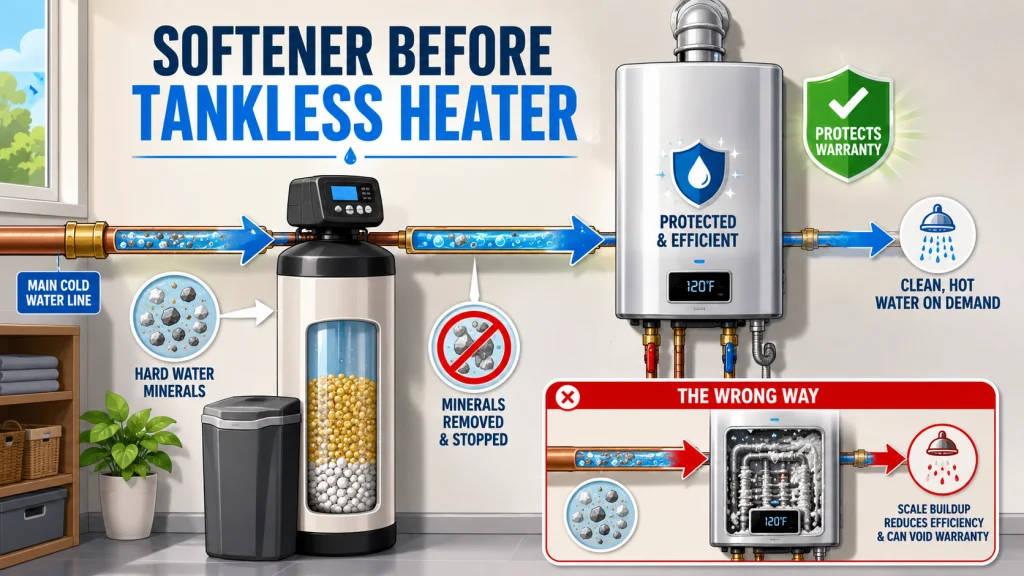
The rule is not complicated. The softener goes before the tankless heater in the plumbing sequence. Water enters the home, passes through the main shutoff, goes through the softener, and then reaches the tankless unit. Every gallon that heater ever processes has already had its hardness minerals removed. If the softener is installed downstream of the heater, you are treating cold water for the rest of the house but sending hard water directly into the heat exchanger on every hot water draw. The position determines whether the heater is protected or not.
In most homes, this means the softener sits on the main cold supply line before it branches to feed the water heater. Where it gets complicated is in existing homes where the plumbing runs make that position inconvenient. The answer in those cases is to reroute, not to compromise the sequence. A few extra feet of pipe during installation costs much less than a heat exchanger failure two years later, and softening water after the fact does nothing for scale that has already formed.
The correct sequence for a standard installation looks like this:
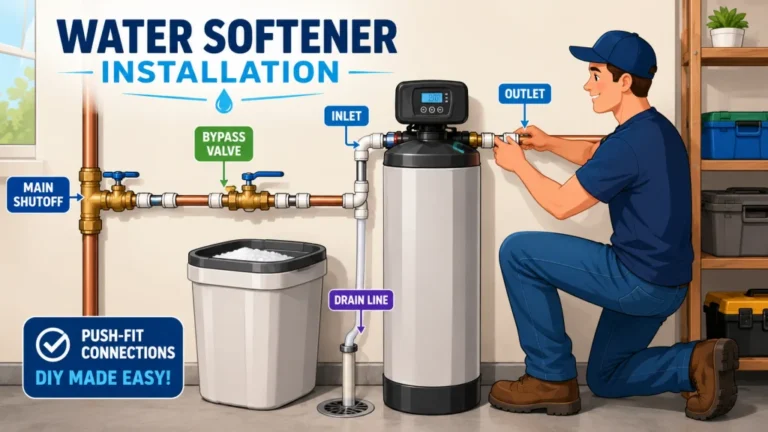
- Main water shutoff at the point of entry
- Outdoor hose bibs and irrigation lines branching off before the softener (softened water applied to soil over time accumulates sodium and damages plants)
- Bypass valve and water softener on the main cold supply line
- Softened cold water continuing to the tankless water heater
- Hot water from the tankless heater distributed to fixtures
The hose bib placement is a detail that has nothing to do with the tankless question specifically, but it comes up on almost every install where the homeowner has not thought about it. The full reasoning is in the water softener placement guide, which covers all the positioning rules that affect both performance and your plumbing downstream.
One common mistake I see on existing homes: the homeowner installs the softener in the utility room near the water heater, which is the right room but the wrong position on the pipe. They tie into the line after the heater branch rather than before it. The water heater continues getting hard water. The rest of the house gets soft water. The scale damage continues exactly as before, and they do not figure it out until the heater throws a fault code.
Flow Rate: Matching the Softener to the Heater’s Demand
Tankless heaters draw water at high flow rates when they are running. A residential unit handling a shower and a kitchen faucet simultaneously is pulling 3 to 5 GPM through the system. A larger whole-house unit at peak demand can reach 8 to 10 GPM. The softener installed upstream needs to handle that service flow rate without creating a pressure drop that the homeowner feels at the fixture. If the softener is undersized for flow, the tankless heater will notice before the homeowner does, often in the form of flow-triggered error codes.
Most 32,000 to 48,000 grain softeners specify a service flow rate of 7 to 12 GPM, which covers the majority of residential tankless configurations comfortably. A household of 3 to 4 people with one standard tankless unit is well within that range. Where sizing matters more is in larger homes with a high-demand unit and simultaneous peak usage across multiple fixtures. The closer your tankless unit’s peak GPM is to your softener’s rated service flow, the more likely you are to feel it as a pressure drop during high-demand moments.
I ran into this exact situation with a homeowner who had paired a 12 GPM tankless unit with a 24,000 grain softener rated at 6 GPM service flow. During morning peak, the pressure drop through the softener was enough to trigger fault codes on the heater repeatedly. The diagnosis took a while because the softener was not the first thing anyone looked at. Replacing the undersized softener fixed it. That replacement cost more than properly sizing it during the original installation would have.
For more on how sizing decisions affect the whole installation, the broader water softener installation overview covers the planning framework, including how to confirm your plumbing configuration before cutting pipe.
Pro Tips: Before choosing a softener for a tankless setup: service flow rate must exceed your heater’s peak GPM, not just match it; 32,000 to 48,000 grain covers most 1 to 4 person households with a standard unit; if your hardness is 12 GPG or above, an ion exchange softener is the safer warranty choice over a conditioner; if you are considering salt-free, check the exact warranty language before buying, not after.

IAPMO certified to NSF/ANSI Standard 44, this system is sized for homes with up to 5 people and 4 bathrooms, using ion exchange to deliver soft, scale-free water from every tap with city or well water compatibility. The user-friendly LCD allows metered operation that uses up to 50% less salt and 28% less water compared to standard time-based softeners, helping lower long-term costs on appliances, soap, and cleaning products. The bundle includes a recommended pre-filter and installation kit, and is backed by a 5 to 10-year limited warranty with dedicated customer support.
Check On AmazonIf you click this link and buy, we earn a commission at no additional cost to you.
The Bypass Valve: What Happens During Regeneration
Water softeners regenerate on a scheduled cycle, usually set for the early morning hours. During regeneration, many single-tank residential softeners either pause softening or allow untreated water to pass through depending on the control valve design. Either way, that 30 to 90 minute overnight window is not the practical problem. A few gallons of untreated water through the heat exchanger once a night is not what causes scale damage over time.
The real concern is the manual bypass valve. That valve is a separate control used during service, maintenance, or testing. When it is left in bypass mode after a salt fill or filter change, the heater runs on untreated hard water continuously until someone notices and corrects it. After any softener maintenance, verify the manual bypass valve is back in the service position before walking away.
This sounds like an obvious step, and it is, but the valve is often tucked behind the unit where it is easy to overlook. On installations where the bypass valve is not easily visible, a simple label or a reminder on the softener itself is worth the 30 seconds it takes to add.

This single-handle stainless steel bypass valve is compatible with Fleck 5600, 5600SXT, 2510, 2510SXT, 9100, and 9000 control valves, making it a reliable fit for a wide range of water softener systems. It simplifies the connection between Fleck control valves and control heads for a cleaner, more straightforward installation.
Check On AmazonIf you click this link and buy, we earn a commission at no additional cost to you.
Salt-Free Conditioners: Not All Warranties Accept Them
Salt-free template-assisted crystallization conditioners work by altering the form of calcium in the water so it is less likely to adhere to surfaces. They do not remove hardness minerals the way an ion exchange softener does. For some applications, this is sufficient. For others, particularly in higher hardness situations, it is not, and the warranty language in your specific model’s documentation will tell you which category you are in.
Some tankless manufacturers accept an approved scale prevention device as meeting their water quality requirements, provided the treated water stays within their specified hardness threshold for scale adhesion. Others require actual soft water, meaning hardness reduced to under 3 GPG by an ion exchange softener, and they do not consider a conditioner equivalent. The difference between these two positions matters because a salt-free conditioner on 18 GPG water is not the same protection as a softener on 18 GPG water, even if the conditioner is functioning exactly as designed.
If you are considering a salt-free system for environmental reasons or because you want to avoid the salt handling and sodium addition, look up the exact warranty language in your model’s installation manual before committing to the equipment. The phrase to look for is whether the document specifies “soft water” with a GPG target or whether it accepts “scale prevention” or “scale inhibitor” as an approved alternative. Do not assume they are equivalent. It is easier to read the manual before installation than to make a warranty claim after a heat exchanger fails at year 4.
Documenting the Installation for a Future Warranty Claim
This part does not come up in most installation guides, but it matters. If the heat exchanger fails years down the line and you need to make a warranty claim, the manufacturer will ask for evidence that the installation met their water quality requirements. Most homeowners have nothing to show. The softener was installed, but there is no record of when, what the water hardness was at the time, or where in the plumbing the softener sits relative to the heater.
Before the heater goes in, document the following:
- The result of your pre-installation water hardness test, with the date it was taken
- The hardness limit from your tankless heater’s installation manual and the specific page it appears on
- A photo showing the softener positioned upstream of the heater on the main supply line
- The softener’s service flow rating and the tankless unit’s peak GPM, both in writing
- Dates of any descaling or maintenance if the manual specifies it as required
This is not about being overly cautious. It is about not being in a position years from now where you know the installation was done correctly but cannot demonstrate it. A warranty is only useful if you can show you met the conditions for it.

Refined to 99.8% purity, these pellets minimize tank residue and are specifically formulated to resist clumping and salt bridges that can cause system malfunctions. By removing hard minerals like calcium and magnesium, they help extend the life of your dishwasher, washing machine, and water heater while preventing scale buildup in pipes. Compatible with all major water softening systems, the 50-pound bag features a patented dual-handle design for easier and safer lifting and pouring.
Check On AmazonIf you click this link and buy, we earn a commission at no additional cost to you.
Final Thoughts: Everything That Can Go Wrong Here Is Easier to Fix Before the Heater Goes In
The installation order, the flow rate match, the bypass valve position, the warranty review: all of it is checkable at the planning stage, when changing course costs nothing. Once the heater has been running on hard water for a couple of years, your options narrow and the cost goes up in proportion.
The short version before installation: test your water hardness, pull the installation manual and find the hardness limit, confirm the softener will be upstream of the heater, and verify the softener’s service flow exceeds the tankless unit’s peak GPM. For the full lifecycle view from installation through ongoing upkeep, the water softener installation and maintenance guide covers it in one place.
If you are also evaluating which softener to pair with a tankless system, the softener recommendations for tankless water heater setups covers the sizing and spec considerations specific to this pairing.

This universal cleaner removes iron, sediment, dirt, and rust from your softener's resin bed, valve, and internal components, tackling the tough buildup that salt alone cannot address. It is compatible with virtually any brand including Whirlpool, Culligan, GE, Kenmore, Morton, and more, making it a reliable maintenance choice regardless of your system. Used every 4 months, it restores softening performance and can extend the parts and labor warranty on EcoPure systems up to 5 years with product registration.
Check On AmazonIf you click this link and buy, we earn a commission at no additional cost to you.
FAQs
⚠️ Will hard water void my tankless water heater warranty?
Yes, if your water hardness exceeds the manufacturer’s stated limit and you have no softener or approved treatment upstream. Most manufacturers set that threshold somewhere between 7 and 11 GPG. Scale damage caused by untreated hard water above that limit is generally classified as a condition resulting from improper installation, not a product defect. The exact limit is in your model’s installation manual under water quality requirements.
💧 Does the water softener go before or after the tankless water heater?
Before. The softener must be installed on the main cold supply line upstream of the tankless heater so that every gallon reaching the heat exchanger has already been treated. Installing the softener after the heater delivers untreated hard water to the unit on every hot water draw, which means the heater is completely unprotected despite having a softener in the house.
🔢 What grain capacity water softener do I need for a tankless heater?
For most residential tankless installations, a 32,000 to 48,000 grain softener with a service flow rate of 7 to 12 GPM is sufficient. The critical check is comparing the softener’s rated service flow against your tankless unit’s peak GPM demand. If the softener cannot match the flow, you will get a pressure drop during peak usage that can trigger error codes on the heater.
🌿 Can I use a salt-free water conditioner instead of a softener with a tankless heater?
Sometimes, depending on your manufacturer’s warranty language. Some accept a scale prevention conditioner as meeting their water quality requirements. Others require ion exchange softening with hardness below 3 GPG and do not treat a conditioner as equivalent. Check your model’s installation manual for the exact phrasing before choosing a salt-free system.
🔧 What happens to my tankless heater when the softener is regenerating overnight?
During regeneration, some systems may allow untreated water to pass through briefly depending on the control valve design. A typical regen cycle runs 30 to 90 minutes overnight, and that short window is generally not the concern. The larger issue is leaving the manual bypass valve in bypass mode after maintenance, which exposes the heater to hard water continuously until someone corrects it.
📋 Do all tankless water heater manufacturers require a water softener?
Not universally. If your water hardness falls below the manufacturer’s stated threshold, typically under 7 GPG, most do not require treatment. Above that threshold, most do require a softener or approved scale prevention device to maintain warranty coverage. Check your specific model’s documentation rather than assuming a general rule applies to your unit.